Why European Airports Are Suddenly a Nightmare — and When It Might Finally Get Better
If you've flown into Europe this summer, or you're watching friends post airport-floor photos with captions like "still in line, send help," you've probably wondered what changed. Europe didn't get more popular overnight. What changed is the border itself — and the fallout has turned routine arrivals into multi-hour ordeals at some of the continent's biggest hubs.
Here's the actual reason behind the chaos, and a realistic read on when it starts to ease.
The cause: a brand-new border system launched right into peak season
Since April 10, the EU's Entry/Exit System — EES for short — has been rolling out across the entire Schengen Area. It replaces the old passport-stamp system with digital biometric registration: every non-EU traveler entering for the first time now needs a fingerprint scan and a facial photo taken at the border, on top of the usual passport check.
On paper, it's a reasonable upgrade — better tracking of who's in the Schengen zone and for how long, less paperwork, harder to forge. In practice, it added several extra minutes of processing per traveler, at airports that weren't staffed or equipped to absorb that on top of already-heavy summer volume.
A few things collided at once to make it worse than a routine "new system, minor hiccups" rollout:
- No exemptions, anywhere. Every non-EU passport holder — American, British, Canadian, Australian, it doesn't matter — goes through the same biometric step at every Schengen air, land, and sea border. Greece briefly tried carving out an exception for UK travelers and was forced to reverse it. There's no fast lane around the requirement itself.
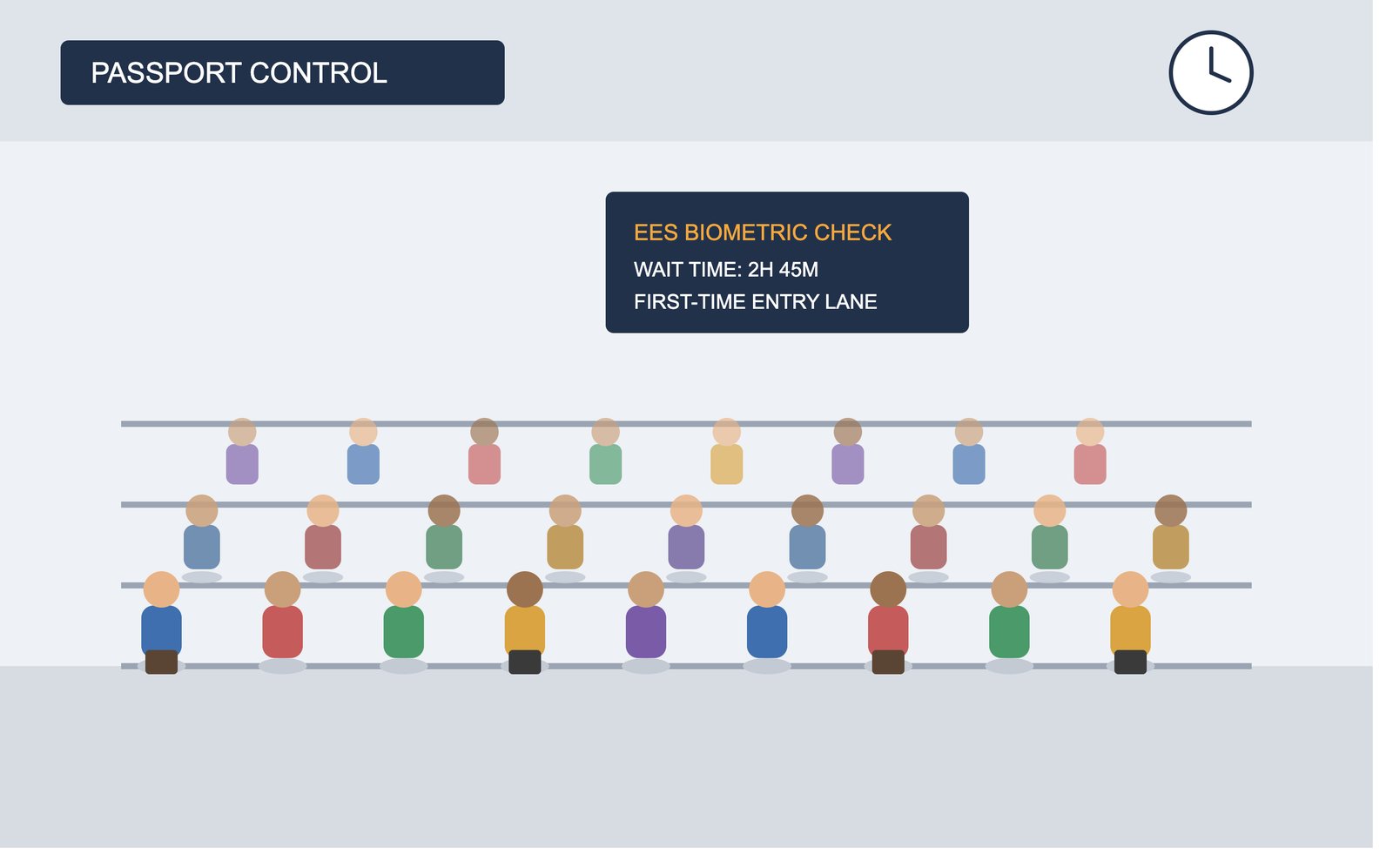
- First-time registrations are the bottleneck. Once you're in the system, re-entry is a quick face check. But summer means an enormous wave of first-time travelers hitting the kiosks simultaneously, and each one adds real time — reports put it at roughly 3 to 7 minutes per person, which adds up fast across a jumbo jet's worth of arrivals.
- Understaffing and tech failures. Airports Council International (ACI) Europe has reported border checks running up to 70% longer at some locations, and that's before accounting for outright system outages — Copenhagen saw a queue balloon to three hours when kiosks failed entirely.
- It's concentrated at the worst possible hubs. Amsterdam Schiphol, Paris Charles de Gaulle, Frankfurt, Lisbon, and several Spanish and Swiss airports have taken the brunt of it, largely because they handle the heaviest long-haul arrival volume from Asia, the Gulf, and the Americas — exactly the routes full of first-time EES travelers.
The result: IATA has warned that the worst-hit hubs could see waits stretch to six hours at peak, and individual travelers have already reported exactly that at multiple airports this summer. A 90-minute layover through somewhere like CDG, once perfectly safe, is now genuinely risky if you're a first-time entrant.
When does this actually get better?
There are real, dated mechanisms in motion here — this isn't just "it'll sort itself out eventually."
Short term — the suspension valve. EU member states are allowed to pause biometric checks temporarily when queues get bad, reverting to old-style manual passport stamps to relieve pressure. Germany has already activated this "flex mode" during peak arrival waves. But it's a release valve, not a fix — and the window to use it at all closes EU-wide no later than early September 2026, even though airports and airlines have lobbied (so far unsuccessfully in some cases) to extend that flexibility through October.
Late summer to fall — the structural fix. Frontex, the EU's border agency, has set a September target for resolving the operational issues driving the worst delays — more kiosks, better staff allocation, ironing out the software problems behind outages like Copenhagen's. Airlines UK's chief executive summed up the current state bluntly: "I think we've got some work to do." Translation: expect gradual, not instant, improvement as that target approaches.
The bigger long-term driver — most travelers simply get registered. This is the part that matters most for anyone flying to Europe repeatedly. EES only demands the full fingerprint-and-photo process on your first entry after the system went live. Every trip after that is a quick face check, not a fresh biometric scan. As millions of travelers cycle through their first EES registration this year, the total pool of "first-timers" causing the worst delays shrinks. By definition, the system gets faster the longer it's been running — this summer is close to the worst it will ever be.
Q4 2026 — a second system layers on top. Worth knowing: EES is actually the foundation for ETIAS, a separate pre-travel authorization requirement (similar to the US's ESTA) set to launch in the last quarter of 2026. It won't add biometric lines at the airport itself, since it's an online pre-approval you get before you fly — but it's a sign the EU is still mid-buildout on its border overhaul, not finished with it.
What you can actually do about it right now
- Build in real buffer. The blunt rule circulating among frequent travelers: add 90 minutes to two hours on top of your normal arrival-to-connection time for any first-time Schengen entry. At the worst hubs, some travelers are budgeting four to five hours.
- Avoid tight connections through the worst offenders — Schiphol, CDG, and Frankfurt are consistently named as the roughest right now.
- Check if your destination uses pre-registration. Portugal and Sweden both offer apps that let first-time travelers submit biometric data before arrival, cutting the kiosk line down substantially. More countries are expected to follow.
- Consider your entry point. If your itinerary is flexible, routing your first Schengen entry through a smaller, less congested airport — rather than a major long-haul hub — can mean a dramatically shorter first-time registration wait.
- Know that it's a one-time tax. Once you're registered, you're registered. The painful part of EES, for most travelers, only happens once.
The system isn't going away — and honestly, once the backlog clears, it's designed to eventually make border crossings faster than the old stamp-and-stare process. But "eventually" is doing a lot of work in that sentence. For this summer and likely into early fall, the smart move is simple: pad your schedule, pick your airports carefully, and treat every first EU entry like it might take a while.
— The fyiFlyNow Team